LLM and GenAI engineering
LLM-based systems, prompt engineering, fine-tuning, generative AI applications, and experiments with AI agents and agent frameworks.
Software Developer - AI & Backend
I work at the intersection of AI and software engineering. I am interested in not only using AI technologies but understanding them, and integrating them into reliable software systems that solve real problems.

I work with LLMs, RAG systems, embeddings, prompt engineering, fine-tuning, document processing and Python-based AI applications, while also deepening my understanding of the foundations of machine learning and deep learning.
LLM-based systems, prompt engineering, fine-tuning, generative AI applications, and experiments with AI agents and agent frameworks.
Retrieval-augmented systems, embeddings, chunking and vector search with PostgreSQL and pgvector.
OCR with Tesseract, AI vision, document cleaning and content extraction, AI-based text processing.
Natural language processing, neural networks, computer vision, model training, and the mathematical foundations behind them.
Python and Django backends, API-based services, SQL and PostgreSQL, containerization with Docker.
Constraint satisfaction and SAT-based optimization, linear and logical constraints, software architecture.
A Django web application that supports project administration by generating documentation and specifications with small, freely available language models on minimal hardware.
Generates CVs and cover letters in English and Hungarian from one YAML content source, using Jinja2 templates and a LaTeX class, with per-application overrides and reproducible PDF builds.
A Python and Jinja2 generator that builds several static websites from one source for shared Apache hosting, with image optimization, generated SEO files and an upload-friendly change list.
A static Astro site in English and Hungarian that presents projects, technology notes and research together with their connections, with client-side search and a knowledge graph, without a server or third-party services.
My interest in AI began during my university years, when I started experimenting with the first LLMs and chatbots that could communicate in natural language and help with programming tasks. At first this steered me towards practical uses of NLP and generative AI; later I became more interested in what happens behind the technology. In Python I worked on machine learning and image processing projects, training models and working with neural networks and computer vision, and alongside them I studied how machine learning, deep learning, algorithms and the underlying mathematics work. In my thesis I studied the practical use of language models and prompting techniques.
I currently work as an AI developer. Besides building LLM-based systems, RAG, embeddings, prompt engineering, fine-tuning, document processing, OCR, AI-based text processing and Python systems, my work also covers classical software engineering and optimization problems. I am particularly interested in integrating AI capabilities into reliable, well-designed software systems, so I want to understand the technologies behind them, not just use them. In the coming years I want to grow towards an AI Engineer / Software Engineer role where I can independently design and build complex AI-based systems while keeping a research and experimental mindset.
For me, AI should not replace engineering thinking but serve as its tool. I use LLMs and vibe-coding-style tools mainly for faster prototyping, learning, experimenting and supporting the development process, while I consider it important to truly understand the code, the architecture and the technologies used. I like to examine a problem from several angles, experiment with different solutions, and then turn the working result into a real software system.
2025 - present
Software Developer
Eszterházy Károly Catholic University, IT Development Department
Design, development and integration of Python-based systems that use AI, including model training and optimization. Technology areas: LLMs, RAG and embeddings, prompt engineering, fine-tuning, document processing and OCR (Tesseract, AI vision), AI-based text processing, and constraint-based optimization (SAT solving, linear and logical constraints). Experimenting with agent frameworks. Technologies: Python, PostgreSQL, Django.
2023 - 2024
Teaching Assistant (Demonstrator)
Eszterházy Károly Catholic University
Supported three practical courses. High-Level Programming Languages I: procedural programming in C# (types, variables, operators, selection and iteration, arrays, lists, dictionaries and records, text file handling, pseudo-random numbers, methods). High-Level Programming Languages II: object-oriented programming in C# (classes, constructors, inheritance, abstract classes, interfaces, LINQ, delegates and lambda expressions, exception handling, generics, GUI programming) and planning and implementing independent projects. Application Development and Project Lab I: agile and classical project methods (Scrum, Kanban), Git-based version control and task tracking, requirement and functional specifications, system plans, UML diagrams, prototyping, testing, documentation and software quality assurance. Technologies: .NET, C#, Git, GitHub, UML, Trello, Markdown.
2022 - 2025
Web Developer and Maintainer
Kepes György College for Advanced Studies; individual client (2022 - 2024)
Website development, maintenance and design with HTML, CSS and JavaScript, including content updates and technical operation. At the College also head of the external communication working group, financial officer and secretary.
2022 - 2025
BSc in Software Engineering
Eszterházy Károly Catholic University
2018 - 2022
Computer System Maintenance Technician
Váci SZC Petőfi Sándor Technical School
Technologies and areas I work with, grouped by type.
Every project goes through the same stages, from the first idea to the published result. A readiness check decides when an idea is ready to be built, and research stays tied to concrete project needs. The Method page explains the stages and how languages, technologies and projects relate.
Idea
Planning
Research
Architecture
Implementation plan
Readiness check
Decision pointImplementation
Result
Publication
Completed courses and certifications.
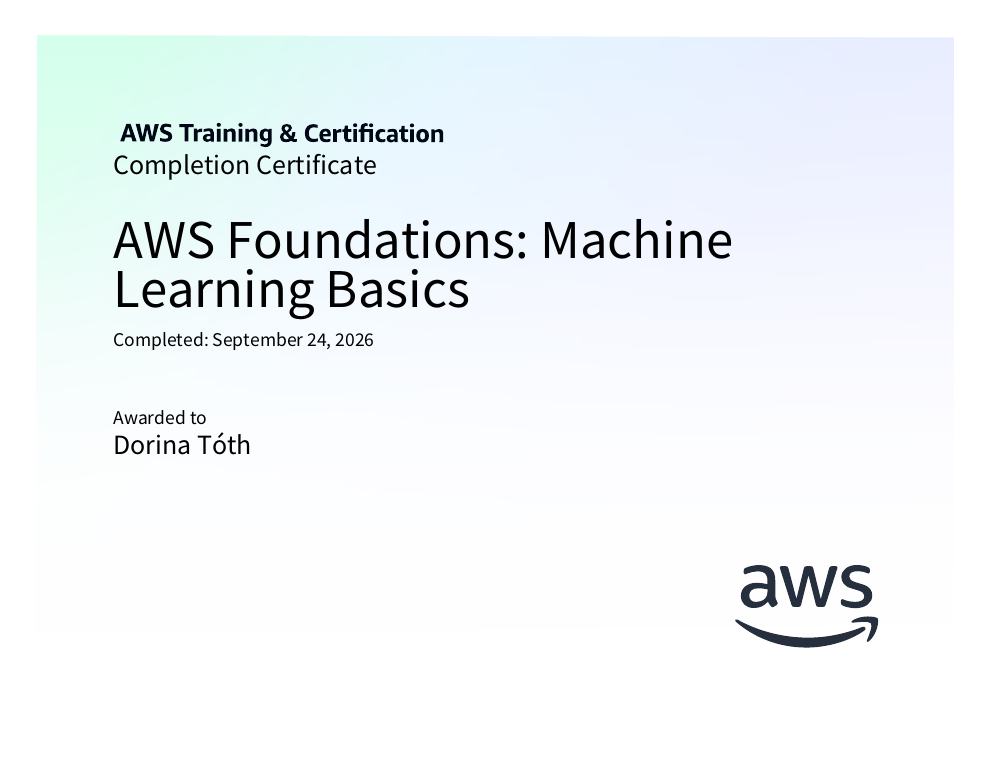
AWS Training and Certification · Issued: 24 September 2026
An overview of machine learning concepts, terminology and processes: what ML is, how it solves business problems, when a model is appropriate, and the phases of an ML pipeline.
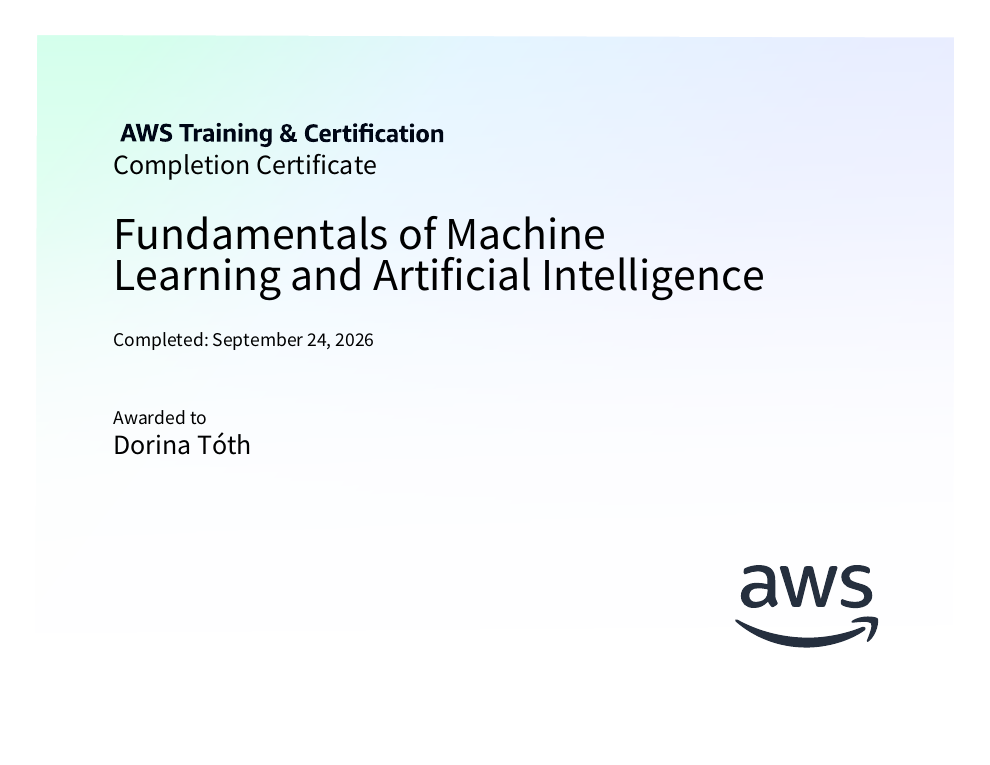
AWS Training and Certification · Issued: 24 September 2026
Foundations of ML and AI and how AI, ML, deep learning and generative AI relate. Covers training data types, learning paradigms, neural networks, the foundation model lifecycle, and AWS services that use AI.
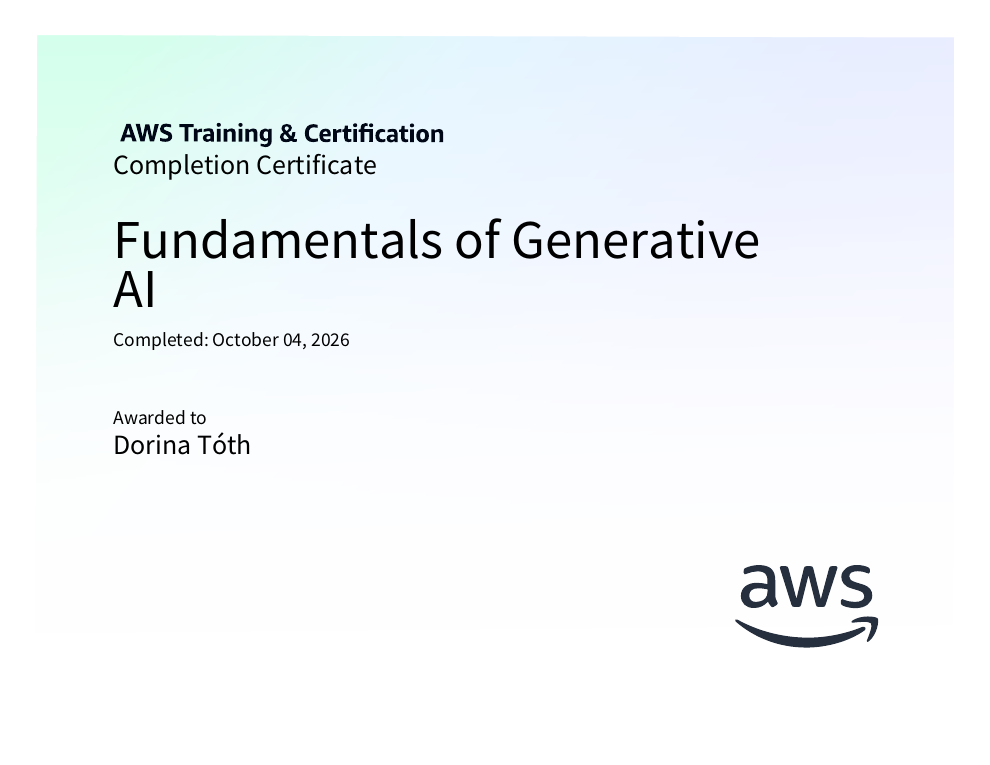
AWS Training and Certification · Issued: 4 October 2026
An introduction to machine learning and generative AI, including NLP, and to AWS AI/ML offerings such as Amazon SageMaker and Amazon Bedrock. Covers data preparation, model training, deployment and monitoring, and choosing an appropriate AI/ML solution for a use case.